I recently worked for a global freight forwarding company where I was involved in a project regarding data management. At some point I bumped into this model:
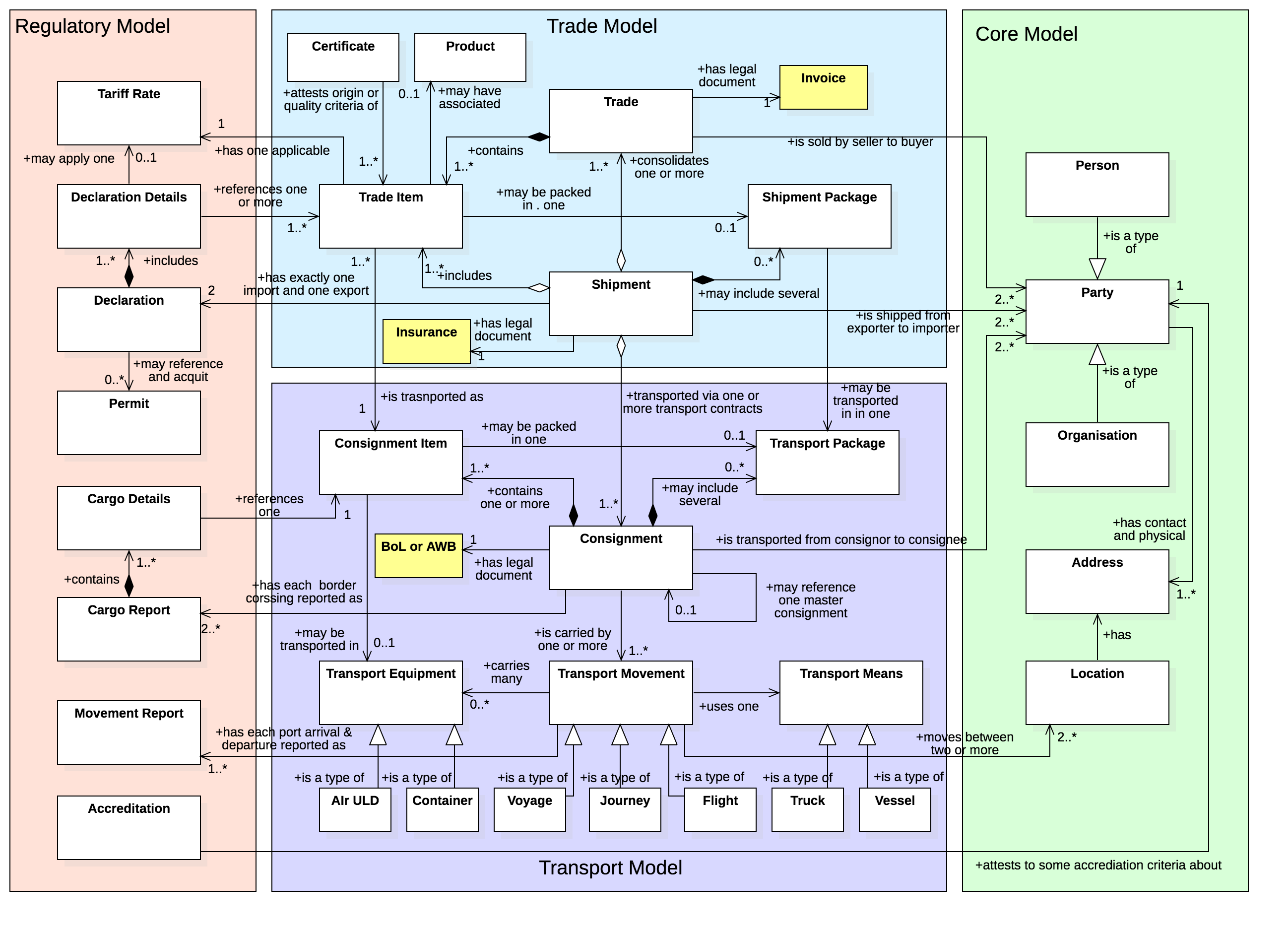
The information here is really overwhelming – but in my opinion a fully zoomed out diagrams as this is essential if we want to be precise and aligned on our business process definitions, data model designs and data management principles. I use the term fully zoomed out here as an analogy to be looking at a geographical map – where we know that:
- We have selected a geographical area to present, and hence accepted that there will be neighboring areas that we have not included – potentially with important boundary connections.
- The zoom level will cut away lower level details and higher level connections.
Explaining the model
For me the above diagram has a number of important aspects:
- At a high level the entities in the diagram are enough to describe all the most important things. Hence all other entities are either less important or are subsets or characteristics of what’s mentioned in the diagram.
- All entities have distinctive characteristics.
We usually refer to these attributes collectively as MECE – which stands for mutually exclusive and completely exhaustive. Language, however, is incredibly diverse, enabling us to easily uncover synonyms and hybrid concepts. Nonetheless, our primary objective remains to attain the MECE quality when we create data models.
The diagram is neatly segmented into subject matter areas, commonly referred to as domains. These include the Core Model (or fundamentals), Regulatory, Trade, and Transport. Within each domain, there exists a specialization in subject matter, leading to potentially varied interpretations of the same term. For example, the term “customer” may hold different meanings across the organization:
- Legal Department: Someone with the right to sign
- Operations: Someone we are delivering to
- Accounting: The person we send the invoice to
- Finance: Legal units or groupings or partitions of legal units that we have contracts with
- Marketing: Some one we can drive a sales process with.
Hence a diagram as the above will give us the opportunity to be clear on our definitions.
The diagram also encompasses a relation description and cardinality. The cardinality serves as a distinguishing factor to concept maps, as it elucidates constraints within the model, whether due to the exclusion of certain relations or the selection of a cardinality of 1 over N for the sake of simplicity. The relation description can convey significant information, although in this instance, the majority of relations are characterized by rather vague descriptions.


 sunevang
Leave a reply to My IT Architect Principles – sunevangconsult Cancel reply